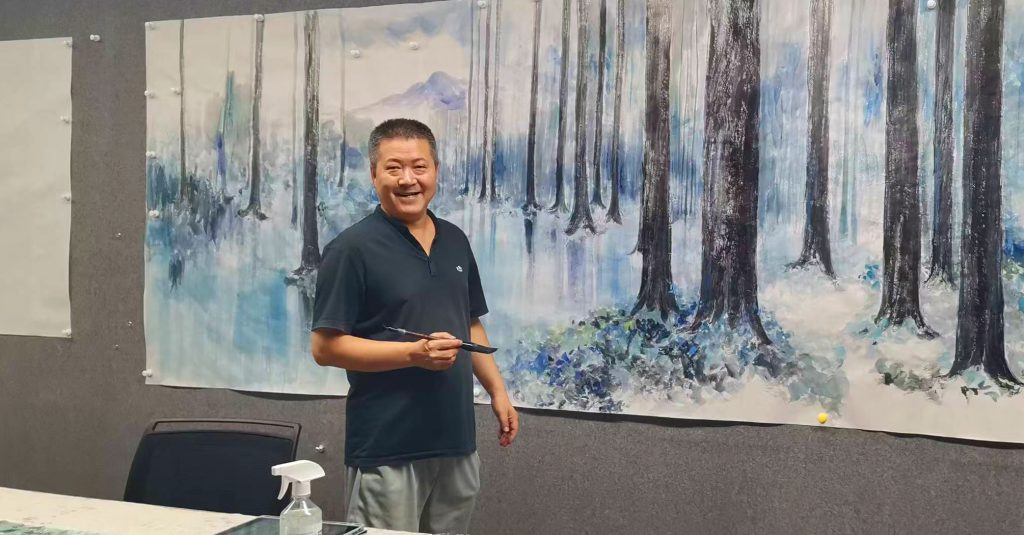
幻彩写意之路 (The Path: 1979-Now)
四十五年笔耕:一条从天赋到体系的孤独天路
Forty-Five Years of the Brush: A Solitary Celestial Path from Gift to System
摘要 (Abstract): 本文以编年体与关键节点叙事,追溯艺术家木然公(卢冠宇)自八岁提笔至今四十五年的艺术长征。从其少年时于鲁迅美院教授课上的惊鸿一瞥,到二十岁时第一幅“幻彩写意”原作的诞生,再到与恩师然师的相遇、体系的确立与国际视野的展开,完整揭示“幻彩写意”并非横空出世,而是一条由无尽实验、哲学叩问与生命感悟铺就的“天路”。
(This essay traces, through chronology and key moments, the forty-five-year artistic Long March of Mu Ran Gong (Lu Guanyu) since first picking up a brush at age eight. From a teenage epiphany in a class taught by professors from the Luxun Academy of Fine Arts, to the birth of his first “Fantasy-Color Freehand” painting at twenty, to encounters with his master Ran Shi, the establishment of his system, and the expansion of his international vision, it fully reveals that “Fantasy-Color Freehand” did not appear out of thin air, but is a “Celestial Path” paved by endless experimentation, philosophical inquiry, and life realization.)
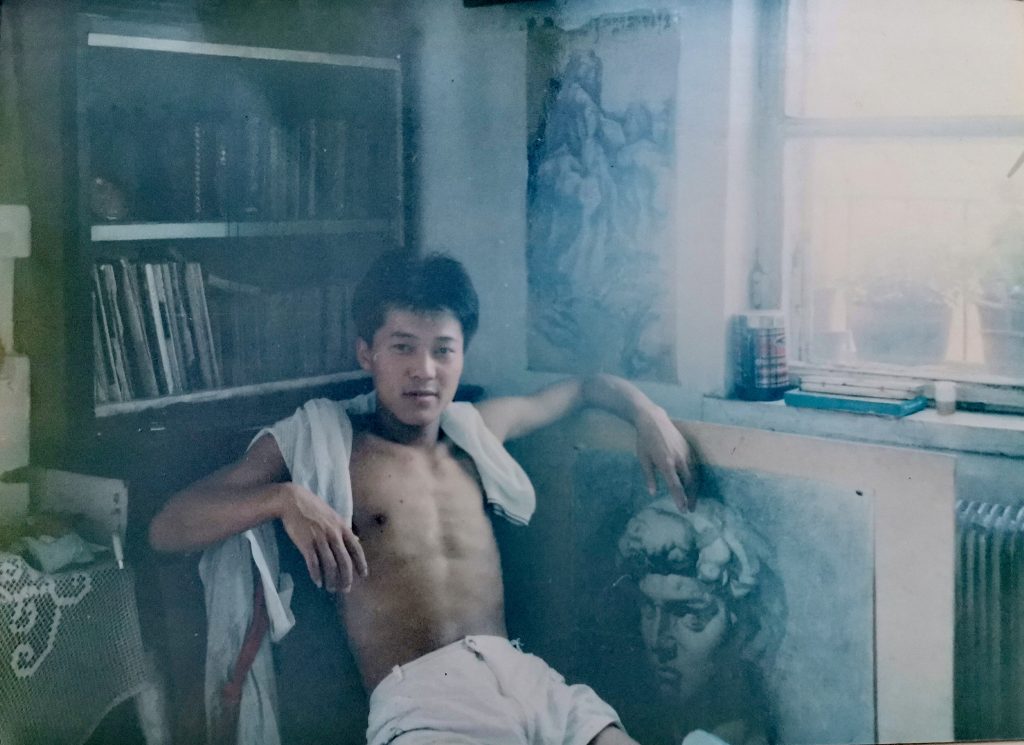
“十六岁,鲁迅美院郑波教授的课上,满墙习作中,他的雨伞点中了我的画——‘就这张领会了我的意思’。那一刻我明白,天赋不是技巧,是瞬间贯通。二十岁,第一张用色冲破墨规的‘幻彩’原作诞生,它青涩、猛烈,是我与古人对话的第一声自己的回音。这条路,我已走了四十五年,从少年得志的线性素描,到中年构建的非线性宇宙心象。每一幅作品,都是这漫长修行路上的一座驿站。”
(“At sixteen, in Professor Zheng Bo’s class from the Luxun Academy, amidst a wall of studies, his umbrella pointed to my drawing—‘only this one grasped my meaning.’ In that moment, I understood: talent is not skill, but instantaneous penetration. At twenty, the first ‘Fantasy-Color’ painting, where color shattered ink conventions, was born—awkward, vehement, it was the first echo of my own voice in dialogue with the ancients. This path, I have walked for forty-five years, from the linear sketches of a gifted youth to the non-linear cosmic heartscapes constructed in midlife. Each painting is a waystation on this long path of cultivation.”)
Mu Ran Gong’s “Temporal Overlays” is not merely a technique but the practical application of a unique historical perspective and philosophy of time on canvas. He treats the painting surface as an archaeological site with depth, where each layer of color and ink represents the implantation and dialogue with the artistic “DNA” of a specific era.
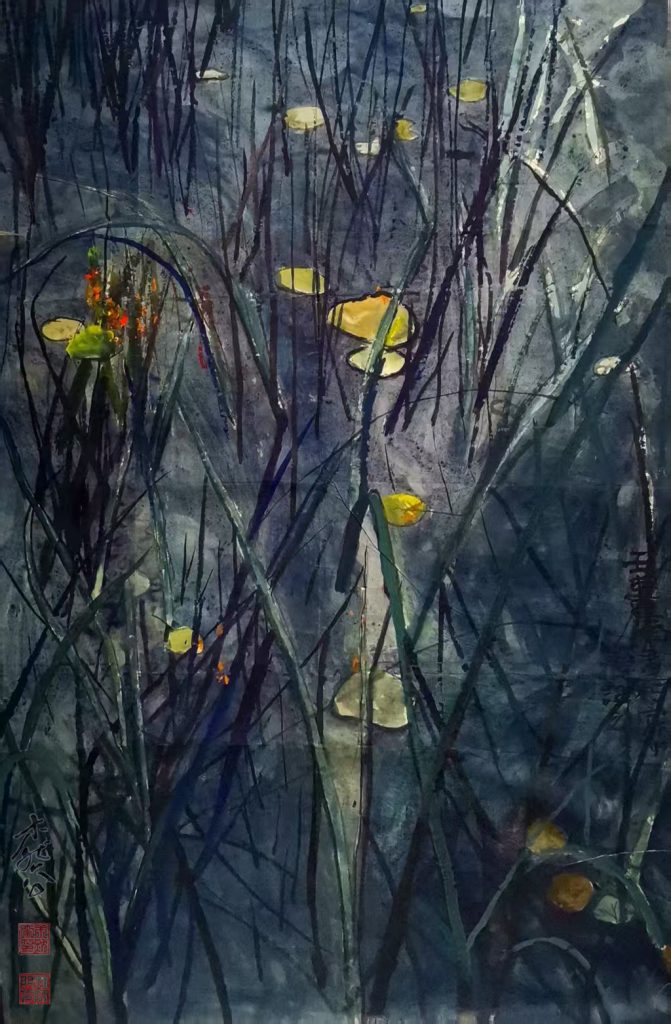

The foundational layer may harbor the majestic holism and cosmic order of Song Dynasty landscapes; within it flow the austere brushwork of Bada Shanren and the expressive splashes of Xu Wei; the middle layer incorporates the scientific dissection of light by the Impressionists and the emotional color of Expressionism; the surface shimmers with the mineral texture of Dunhuang frescoes, weathered by millennia, and the planar logic of modern design. This “overlaying” is never mechanical collage but resembles sedimentation, compression, and uplift in geological movements, allowing aesthetics from different times and spaces to collide and permeate, giving birth to entirely new visual life.
This results in the rare “historical penetrability” of his works. The viewer simultaneously senses the vastness of ancient artistry and the acuity of contemporary expression within a single moment. Wu Changshuo’s “spirit of metal and stone” is outlined with colored lines; Pan Tianshou’s “precarious composition” is infused with flowing light. This approach prevents “Fantasy-Color Freehand” from becoming a rootless fashionable style, instead positioning it as a living, ever-evolving tradition. It answers a crucial question: in the age of globalization, how does tradition survive? Mu Ran Gong’s answer: by transforming it into “genetic fragments” that can be decomposed, recombined, and translated for the contemporary era, achieving true resurrection and evolution through overlay.